Four Basic Principles When Praying.

Matthew 18: 19 “If two of you shall agree on earth as touching any thing that they shall ask, it shall be done for them by my Father which is in heaven.”
20. “For where two or three are gathered together in my name, there am I in the midst of them.”

To have results in unity prayer, one must bare in mind that there are basic principles to follow:

1) Learn to be lead by the Spirit of God all the time.
Rom. 8: 14 “For as many as are led by the Spirit of God, they are the sons of God.”
Eph. 6: 18 ” Praying always with all prayer and supplication in the Spirit,”
Praying in the Spirit aids the believer to pray God’s will.

2) Learn to be open with the Lord and each other.
1 John 1: 7-10
James 5: 16
If we are not free it will hinder our intercession as well as others with whom we are interceding.

3) Learn to be still.
Psalms 46: 10 “Be still, and know that I am God: I will be exalted among the heathen, I will be exalted in the earth.
Eccl. 5: 2 “Be not rash with thy mouth, and let not thine heart be hasty to utter any thing before God: for God is in heaven, and thou upon earth: therefore let thy words be few.”
Take time and listen to God’s Spirit and get to know Him and His ways.

4) Learn to hear what God is saying.
John 10: 4 “And when he putteth forth His own sheep, he goeth before them, and the sheep follow him: for they know his voice.”
Isaiah 30: 20-21


The Search For Satisfaction

When it comes to jigsaw puzzles, we all know that to enjoy a satisfying outcome you need all the pieces. In many ways, life is like that. We spend our days putting it together, hoping to create a complete picture out of all the scattered parts.


Yet sometimes it seems like a piece is missing. Perhaps we’ve been pursuing the wrong pieces to the puzzle. Even though we may know that life without God at the center is a life that as lost the most important piece, do we live as though He isn’t particularly relevant? And even though we may attend church regularly, is He the trobbing center of our lives? Sometimes we grow accustomed to feeling distant from God. This makes it easier to sin, complicating the sense that something important is missing.


But no matter how far we may drift from God, He wants us near. He appealed to His people through the prophet Isaiah: “Why do you spend money for what is not bread, and your wages for what does not satisfy? Listen carefully to Me, and eat what is good, and let your soul delight itself in abundance” (Ish. 55: 2).


If something is missing in your life, remember that God is the only One who can fully and abundantly satisfy you. Let Him complete the picture of your life. – Joe Stowell.


FROM BREAKDOWN TO BREAKTHROUGH

TEXT: 1 CHRONICLES 4: 9-10

INTRODUCTION

David’s prayer – Ps. 25: 4 “Shew me thy ways, O Lord; teach me thy paths.

Ps. 27: 11 “Teach me thy ways, O Lord; and lead me in a plain path.”

Ps. 51: 10 “Create in me a clean heart, O Lord; and renew …”

Jabez prayed – “Enlarge my coast,” v10.

“LIVING BIGGER FOR GOD”

We can pray the very same prayer that Jabez prayed. It is an awesome prayer. When your coast starts to increase, there is going to be certain challenges that you will be confronted with.

1)      Your faith level.

2)      Your pain level.

3)      Your patience level.

4)      The jealousy level will increase.

1)      Your faith level – You cannot live larger for God if you do not have faith. When you live larger for God, you need to trust God wholeheartedly that He will minister
to you. When God starts to minister to you, there is going to be a change. Your
faith grows hearing, and hearing by the Word of God. Anchor on the Word of God.

2)      Your pain level – “Without pain, there is no gain.” Your pain level is going to
increase when you live larger for God. There will be trials, testings and
storms. However, God will supernaturally sustain you. He will not put you where
His grace cannot keep you.

3)      Your patience level – Patience is the fruit of the Spirit. You will grow into
maturity, become more tolerant and have longsuffering. You are now getting
ready to grow larger for God.

4)      The jealousy level – The people you least expect it from, will be jealous of what
God is increasing in your life. Spiritual jealousy will increase against you
when you live larger for God. Maintain a Godly spirit toward such. Remember
Joseph. Genesis 50: 20-21 “But as for you, you thought evil against
me; God meant it unto good, to bring to pass, as it is this day, to save much people alive. Now therefore fear ye not: I will nourish you, and your little ones. And he comforted them, and spake kindly unto them.”

 CONCLUSION

David’s song of thanksgiving – 2 Sam. 22: 37 “Thou hast
enlarged my steps under me; so that my feet did not slip.”

Isaiah 54: 2-3 “Enlarge the place of thy tent, and let them
stretch forth the curtains of thine habitations; spare not, lengthen thy cords, and strengthen thy stakes; For thou shalt break forth on the right hand and the left; and thy seed shall inherit the Gentiles, and make the desolate cities to be inhabited.”

 PRAYER:

Your family and ministry

Your church

Your city, province and nation


WHY ARGUE

Why argue when we don’t know all the
facts and the Pharisees were blamed – we too can be blamed (v.2). Jesus Christ is Lord of the
Sabbath and His law is the law of liberty (James 2:12). He knows the problem that
both the Pharisee and the man with the withered hand have – they are in their
sins. What does He do? He is a God of
love – He said, “Love your enemies
(v.27).” He also wants to save the
Pharisees from the membrane of religion that tied them to their own beliefs.
Christ knows their judgmental thoughts and so He begins to heal the man with the
withered hand to also reach them but their biases come in the way of seeing Him
for what He really is. But He ultimately saves Pharisees like Nicodemus, Joseph
of Arimethea and Saul of Tarsus. When we go to theological college, it is a
general trend to become proud – instead of our learning making us humble, we
become too technical.


In fact we should be
learning how to relate to people. As a music mentor one of my joys is my own
pursuit of also learning from the students I teach on how to relate to them – so
it is not for me to learn music from them because that is my ilk but to learn
how to approach them. Therefore, learning never stops. Concerning the accusation
the Pharisees made about Jesus’ disciples eating grain on the Sabbath, they knew
the allowance of Moses in this matter but they had their own additions to
protect them as the national Jewish people. Moses allowed for immediate needs
such as hunger (Deut.23:25). What
was disallowed on the Sabbath was cutting the grain and selling it. How have we added extra rules to keep others
outside?

When an existing church leadership is hypocritical to the point of
suicide what is the solution?
A new leadership must
be established and Christ goes to a Mountain to pray and does that with a
cross-section of humanity among twelve disciples. Douglas Milne puts it well:
“There were businessmen (Peter & Andrew), a civil servant (Matthew), a
political activist (Simon), hot-tempered brothers (John & James), a natural
leader (Peter), a constitutional doubter (Thomas) and a sceptical believer
(Nathaniel).[i]

Luke is the only Gospel writer
that presents Jesus’ beatitudes with woes. When Moses renews God’s covenant with
the nation of Israel before entering the Promised Land, he too places the
blessings and the curses before the people (Deut.27:11-28:68). In Jesus’ audience what kinds of people are
blessed?
The poor and the hungry! What kinds of people are cursed? The
rich and the popular! There is nothing wrong in being rich but generally the
rich in their hearts have no place for the poor.

When we were still in our sins
and enemies of God, Christ died for the ungodly (Rom.5:6). There is no bias in Christ’s
love – it is not for one’s own race, class, background or culture but across the
divide. How can we apply that to today’s
world?
What about someone who came
into our churches with tattoos or a fellow with pierced ears? How would we
respond?
May those of us who are Christians learn more of Christ to love the
“outsider”!

By the time we come to our
suggested parallel chapter in Exodus
3
we see a loving God who wants to establish a leadership for a people that
He has made for Himself. These
people are not going to just accept Him and His servant Moses, considering that
He allowed them to be in slavery of over four hundred years. It is going to take
a few miracles to convince them. But the miracles start here on this mountain,
Horeb (later to become Sin-ai). Here there is a conversation between God and
Moses – Moses’ prayer life begins here.

God knows
that His leaders among the nation of Israel in Egyptian bondage will be like the
Pharisees – they would eventually fight Moses but nonetheless here the story of
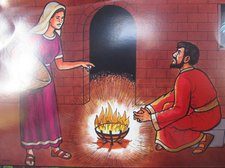
love begins. He places a fire on a mountain for Moses to investigate. He doesn’t
come right down to Moses but down to the mountain so that Moses could reach the
mountain – a picture of the high standard of God’s love and law.

Is God just going to deliver the nation of Israel? Does He only love
them?
He loves to save to the ends of the earth and
so He begins with Israel and by the time they leave, they leave with some
Egyptians. On the Day of Pentecost we see Egyptians being saved and Philip
speaks to an Ethiopian (Acts 8:26).
The Burning Bush has two vivid pictures: the fire of God’s heaven and Satan’s
hell. When Moses was in the valley, at a distance he first saw the fire of God’s
heaven and it reminded him of a fire that once went out. His own fire of anger
crying out for justice but it killed an Egyptian forty years ago. But here he
sees a fire that doesn’t burn the bush out (the Acacia tree). But also when he
investigated closer, it was a reminder of the fire of hell that Israel is going
through in Egyptian bondage. But through Moses and the Burning Bush God sees
future leaders for His church. What Moses experiences, God wants others to
experience (v.12).
Why argue but Moses’ arguments begin here
through an enquiry. Unlike the Pharisees who believed they were everything,
Moses doesn’t believe that he is anything. He says, “Who am I?” God told him that He would
be with him (v.12). If God could be
with an Egyptian daughter of the Pharaoh to name him “Moses” which means “drawn
out from the river”, God will achieve what that meant. He is the natural leader
to draw Israel out of Egypt through the Rivers of the Red Sea – he is the
redeemer. But he wants to make doubly sure that this deliverance story is going
to work. He is still not convinced. Many of us have been going to church for
years but the bush is not burning for us. We haven’t yet trusted God fully.
If God named him “Moses”, now God
finally names Himself for Moses and the nation of Israel to know God by this
name in the future. “Tell Pharaoh that …I AM has sent you (v.14).” In other words, “It is YAHWEH
that has sent you.” This must be a lesson for Moses to connect because on
investigation he would come to know that his mother’s name Jochebed meant “Yahweh is my glory.” God has the big
picture and the details all worked out. Can we ever argue with a God that loves
to make a people for Himself from every nation, tribe, race and
kindred?