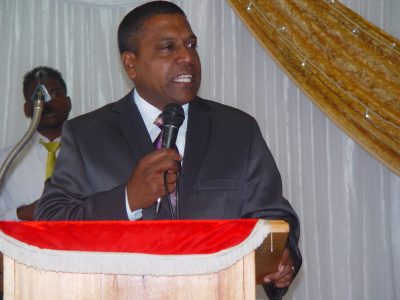
Four Basic Principles When Praying.

Matthew 18: 19 “If two of you shall agree on earth as touching any thing that they shall ask, it shall be done for them by my Father which is in heaven.”
20. “For where two or three are gathered together in my name, there am I in the midst of them.”

To have results in unity prayer, one must bare in mind that there are basic principles to follow:

1) Learn to be lead by the Spirit of God all the time.
Rom. 8: 14 “For as many as are led by the Spirit of God, they are the sons of God.”
Eph. 6: 18 ” Praying always with all prayer and supplication in the Spirit,”
Praying in the Spirit aids the believer to pray God’s will.

2)Learn to be open with the Lord and each other.
1 John 1: 7-10
James 5: 16
If we are not free it will hinder our intercession as well as others with whom we are interceding.

3) Learn to be still.
Psalms 46: 10 “Be still, and know that I am God: I will be exalted among the heathen, I will be exalted in the earth.
Eccl. 5: 2 “Be not rash with thy mouth, and let not thine heart be hasty to utter any thing before God: for God is in heaven, and thou upon earth: therefore let thy words be few.”
Take time and listen to God’s Spirit and get to know Him and His ways.

4) Learn to hear what God is saying.
John 10: 4 “And when he putteth forth His own sheep, he goeth before them, and the sheep follow him: for they know his voice.”
Isaiah 30: 20-21


GOD IS WORKING FOR OUR GOOD

God is so wise and powerful that absolutely nothing can cause His purposes to fail. In fact, He is able to take even those things meant for evil and make them work for good.

Joseph’s brothers hated him so much that they plotted his murder before selling him as a slave. but in Egypt Joseph gained favor of Pharoah, who gave Joseph the no.2 position of authority, During a famine, his brothers came to him for food, not realizing who he was. When Joseph finally identified himself, he said: Do not therefore be grieved or angry with yourselves because you sold me here, for God sent me before you to preserve life” (Gen. 45:5). Later he told them, “You meant evil against me; but God meant it for good, in order to bring it about as it is this day, to save many people alive” (Gen 50:20).

When we’re discouraged because of distressing circumstances and demanding challenges, we can rejoice in God’s wisdom, power, and sovereignty. He is working all things for our good (Rom. 8:28).


Lament Over A Doomed City

Introduction:

No nation is immune to God’s judgement if it lives by the power of the sword and follows a policy of ruthlessness toward other nations. Assyria’s history was one of uninterrupted ruthlessness from beginning to end. Nahum’s satisfaction over the fall of such a cruel and wicked nation was shared by other prophets. Zephaniah wrote: “And he will stretch out his hand against the north, and destroy Assyria; and he will make Nineveh a desolation and dry like a wilderness. This is the rejoicing city that dwelt carelessly, that said in her heart, I am, and there is none besides me: how is she become a desolation, a place for beasts to lie down in! every one that passeth by her shall hiss, and wag his hand.” Zeph. 2: 13; 15.

1) Down-right Wickness of Nineveh. (v.1-4)
Woe! Nineveh is called “the bloody city” or “the city of bloods.” When “bloods” occurs in its plural form, it denotes blood that has been shed through acts of murder and violence. Violence in Nineveh is linked to lies and deceit. Nineveh’s wealth has been gained through lies and deceit.
Read v.2-3.
Only those who have known the horrors of war can fully appreciate a passage like this. It seems obvious that the prophet himself had witnessed the sights and sounds of war and was writing out of his own experience.

2) Nineveh – A Harlot in Distress (v4-7).
” Nineveh is to be punished very severely. “I will discover thy skirts upon thy face and I will show the nations thy nakedness.”
” God himself entered the fray (fight, conflict) against Nineveh. He punished her for the harlot she was.
” Nineveh dropped out of history to no one’s regret because her cruelties had separated her from all other nations.

3) Nineveh is Compared to Thebes (v8 – 11)
The prophet demanded of Nineveh if she thought she were better than Thebes. The real point of the question is whether the defenses of Nineveh were better than those of Thebes. The comparison was appropriate, for the two cities were alike in many ways. Both were capital cities. Thebes, the capital of upper Egypt, lay about four hundred miles of Cairo. Both were located on rivers. Nineveh on the Tigris and Thebes on the East bank of the river Nile. Both considered themselves to be impregnable.
And yet Thebes was conquered about 661 BC by an Assyrian ruler! Although Thebes was situated by the river Nile, and although it was allied with Ethopia and the Libyans, it still did not escape the sword.
Therefore, why should Nineveh escape doom? Her defenses were not as strong as Thebes. She had no staunch allies. The prophet described the city’s fate as that of a person in a drunken stupor, too dazed to defend himself and concerned only with finding a way of escape (v.11).

4) Nineveh – Futile Efforts at Defense (v. 12-18)
Nineveh’s protecting fortresses were like ripe figs ready to fall into a mouth of anyone who shook the fig tree (v12). Her defenders were no better than woman, lacking in courage and unable to defend themselves (v13). To accuse soldiers of being like women was about the worst insult that could be hurled at them in Old Testament times. Modern preachers would be wise to choose a different metaphor! Nahum speaks of the gates of Nineveh as being wide open to her enemies, and fire set to her bars (v13).
The prophet was calling upon the city to prepare herself for defense (v14-17). There is no city so well prepared to provide lasting security for its people, if the city has forfeited its moral right to exist. (No family also) Nineveh could not trust in her large population to save her. Actually, the fate of Nineveh’s ruling classes, her shepherds and nobles, would be far worse. They would sleep the sleep of death with no one to arouse them. Having no shepherd to tend them, the people of the city would be scattered like lost sheep along the mountains, with none to gather them. (v18)

Conclusion: There will be no healing for those that choose to disobey God. Read v. 19.


Four Basic Principles When Praying.

Matthew 18: 19 “If two of you shall agree on earth as touching any thing that they shall ask, it shall be done for them by my Father which is in heaven.”
20. “For where two or three are gathered together in my name, there am I in the midst of them.”

To have results in unity prayer, one must bare in mind that there are basic principles to follow:

1) Learn to be lead by the Spirit of God all the time.
Rom. 8: 14 “For as many as are led by the Spirit of God, they are the sons of God.”
Eph. 6: 18 ” Praying always with all prayer and supplication in the Spirit,”
Praying in the Spirit aids the believer to pray God’s will.

2) Learn to be open with the Lord and each other.
1 John 1: 7-10
James 5: 16
If we are not free it will hinder our intercession as well as others with whom we are interceding.

3) Learn to be still.
Psalms 46: 10 “Be still, and know that I am God: I will be exalted among the heathen, I will be exalted in the earth.
Eccl. 5: 2 “Be not rash with thy mouth, and let not thine heart be hasty to utter any thing before God: for God is in heaven, and thou upon earth: therefore let thy words be few.”
Take time and listen to God’s Spirit and get to know Him and His ways.

4) Learn to hear what God is saying.
John 10: 4 “And when he putteth forth His own sheep, he goeth before them, and the sheep follow him: for they know his voice.”
Isaiah 30: 20-21